
Hello hello faithful readers, I am back, for what I hope will be monthly dispatches to you all once again.
I have finished my book manuscript, and it is out on submission at a couple of different places and with a few different agents, so let’s all take a moment to think good thoughts for it, and that it finds a home. This part of the process is very difficult, because it is comprised mostly of silence, and requires patience. Things I am deeply uncomfortable with. But we have lit a candle, and sent it on its way, and now we simply hope for the best.
The book is currently entitled Wilderness of Bones, and it addresses the conundrum of grieving for our beloved dead, in this case, my two brothers, especially Patrick, who died in an accident in 2003, while simultaneously grieving the erosion of the spectacular physical landscape in which I live as the twin problems of climate change and gentrification escalate here. And everywhere.
A challenge I was faced with at the end of this book is one that nearly every writer who takes nature, wilderness, and our current environmental crisis as a topic, was the problem of hope. How to end the book on “a hopeful note”? How to leave the reader with some uplifting feeling at the end of it all?
Now you have to remember, I thought my first book ended on a hopeful note. Yes, the lost child does not survive, but the family does. The parents’ marriage is intact in the aftermath, their surviving child seems to be doing reasonably well, the mother is making art. To me, this was a hopeful ending. To the elderly lady who wrote me an enraged letter, and to several reviewers, not so much.
Clearly I have a vexed relationship with the concept of “hope.”
However, mere days after I handed off the manuscript to someone who had requested it (fingers crossed) we left for a trip to Alaska. I have to admit, writing to this publisher that “We’re leaving on a trip to Alaska and I’m not sure I’ll have connectivity …” made me sound much cooler than I actually am. We spent a couple of days on Whidbey Island visiting my stepmother in her fabulous house she bought a couple of years ago, then caught the Alaska Maritime Highway Ferry in Bellingham. We splurged for the entirely reasonable 2 bunk berth, and settled in on the side deck with discrete beers in our water bottles, and a delicious cheeseburger and fries from the snack bar as we watched Vancouver Island hove into view.
The ferry restored my faith. It was the anti-cruise. While there were, of course, a couple of annoying people, it was mostly regular folks, who were there to watch the scenery roll by, or simply to get home. Many of them had vehicles in the hold, often with dogs who they were allowed to go down and walk for 20 minutes every six hours. Other people pitched tents on the back deck, or brought sleeping pads and bags and camped out on the covered upper deck in the lounge chairs. Still more people camped out in the foredeck observation room, or at night, in the movie room (that mostly seemed to show kids movies during the day). There was a snack bar and a full restaurant, and a bar that served a limited but perfectly fine assortment of beverages. There was a distinctly DIY vibe, with a dirtbag edge to it that felt like home to us. We spent most of our time up on the top back deck, watching the astonishing scenery roll past, and spotting whales with a group of other equally delighted people.
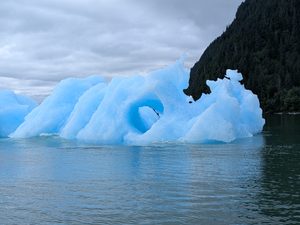
Thirty six hours later we got off in Petersburg, where we spent a couple of days with an old friend of Chuck’s who bought a cabin there a few years back. We did some fishing and caught some halibut. We spent an afternoon exploring the LeConte glacier, and the icebergs that had spalled off it, icebergs that were actually the color of the one at the top of this post. The ice was blue. It wasn’t just the way the light refracted through it, the ice was actually blue. There were whales and sea otters, and the last morning as we were waiting on the tide to come in so we could return to town, a pod of porpoises swam past.
It wasn’t all an idyll however. We had a seven hour layover in Ketchikan to wait on the tides through the Wrangell Narrows into Petersburg and it was a horrifying introduction to the tourism nightmare that is the cruise industry. There were three gigantic cruise ships that had docked when we were there. Not only was the town overrun with crowds of deeply ignorant and incurious people who treated it like an “attraction” not like a place where people actually live, but the entire waterfront was taken up by these strange jewelry and makeup stores. In Alaska?!? With alarmingly aggressive salespeople in every doorway. I had to look it up once we got back to the ferry, but apparently the cruise industry has long advertised “cheap” goods in ports as a kind of amenity? Like duty free stores in the airports, the ones that are no bargain at all? It was deeply unsettling, and the thousands of salmon swimming upstream through the fish ladder in the center of town, with all the ones who hadn’t made it swirling in the eddies, only added to the slightly insane feeling of the whole experience.
I liked Alaska in many ways. It was spectacularly beautiful. I’d forgotten how much of my childhood was spent in fishing and speed boats, and it was a delight to be back on the water again. The sound of humpback whales blowing nearby in fog so thick we couldn’t see them? Something I won’t forget.
But it was also a place where there’s a continual edge of violence. We were in a cannery town where I’d not have felt comfortable if I hadn’t been with Chuck. There was a little too much alcohol, and a little too little regard for ordinary safety, and the groups of men from the fishing lodges had the slightly hysterical vibe of guys who have been showing off for one another all week, and who could, without much warning, decide to take something too far. So I don’t think Alaska goes on our list of places we might consider moving to, although we did have a nice trip.
Back to the topic of hope. There was an article that came across my feeds a couple of months ago by Daegan Miller that I’ve been thinking about ever since. “Lessons in Living in the Anthropocene (From the World’s Most Pessimistic Climate Writer)” As an Old, I remember when Roy Scranton’s book Learning to Die in the Anthropocene came out, but I missed the apparent kertuffle in which more established environmental writers dismissed and demonized his work for being “too pessimistic” or “doomerism.” To be fair, there was a lot of kertuffle in the early days of discourse about the anthropocene as a concept — my favorite moment was the local author who, as I was discussing what I was reading and working on, asked me with horror if I “even believed in God.” Sigh. The concept of “the wild” has long been tangled up with Romantic ideas of the sublime that do, for many, lead to a kind of religious faith, and so, there was a lot of that kind of reaction.
Frankly, I found Scranton a breath of fresh air. He wasn’t trying to convince any of us that we can get out of this. He was also not falling for the idea that since we’re all doomed, there’s “nothing we can do” so we might as well do anything we want. I’m about halfway through his new book, Impasse: Climate Change and the Limits of Progress, the one Miller discusses in the article above, and it’s very good. Parses the philosophical geneologies of the ideas and approaches to our current crisis, explores what strains of thought have brought us to the place we are, and dissects some of of our most cherished blind spots, including the Myth of Progress, in ways that could, if we were brave enough to actually change our ways of living, perhaps see us through.
What I find most hopeful about thinkers like Scranton is that they are not pretending that everything is going to be okay. He’s not pretending that we can just Hope and Change our way out of this. As someone who learned long ago, when my youngest brother died of cancer, that there’s no wishing anyone back from the dead, that hard limitations do actually exist in our lives, I find this kind of truth telling a tonic.
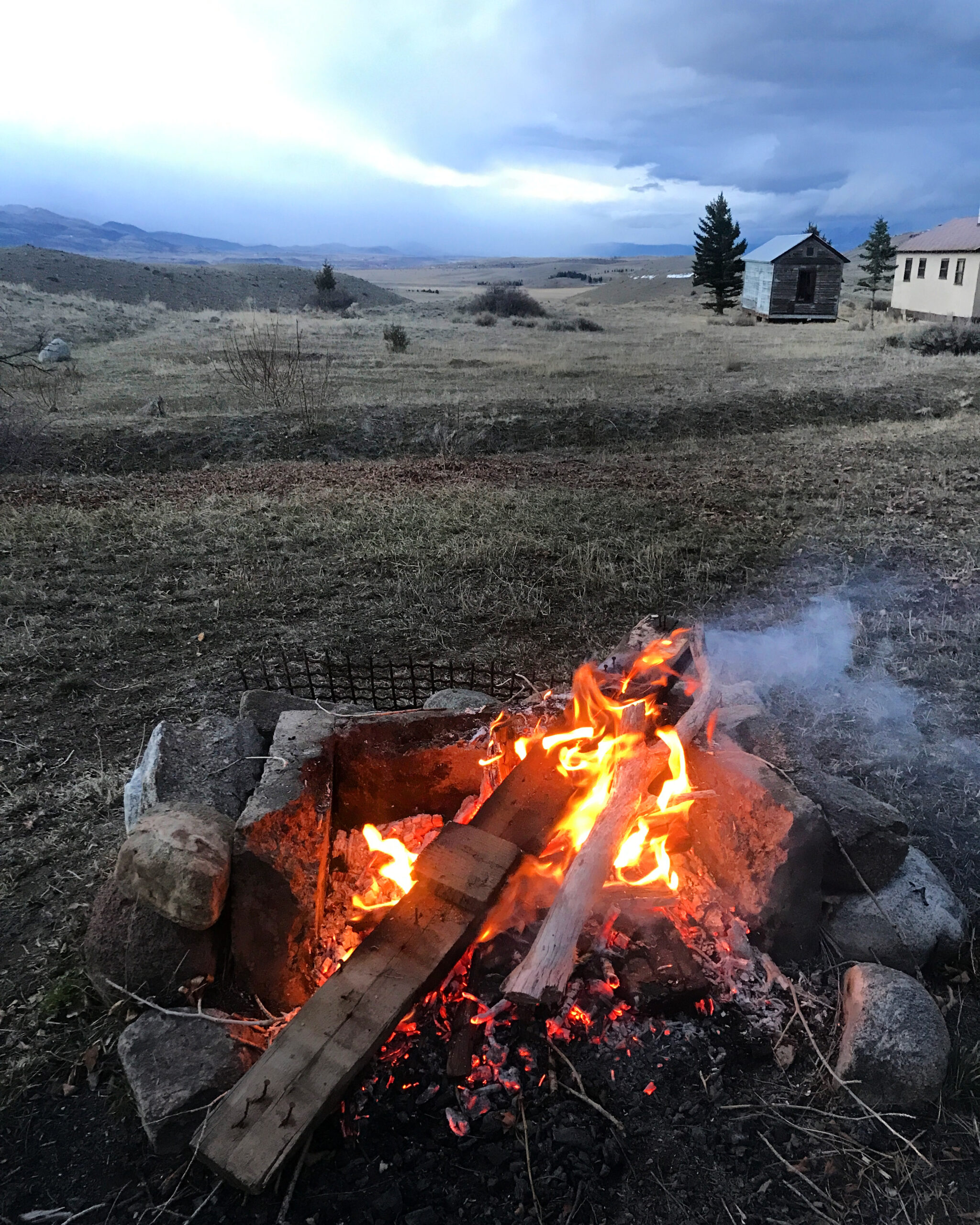
And since the best way to cope with the very slow pace of placing a book project is so start another one, that’s what I’m currently working on. This little Getting Dirty space has always been a sandbox for the work I want to do on materiality, and the natural world, and how our increasingly virtual relationship to the physical world impacts our relationship with the world itself. So I hope you’ll all come along for the ride as I spitball ideas in this space, and grope my way through the dark toward the next book. Because the one and only true flame of hope that burns in my heart is the one that believes that it is by making things that we survive, whether we’re making art or dinner or space for wild nature.

Leave a Reply