Roadkill
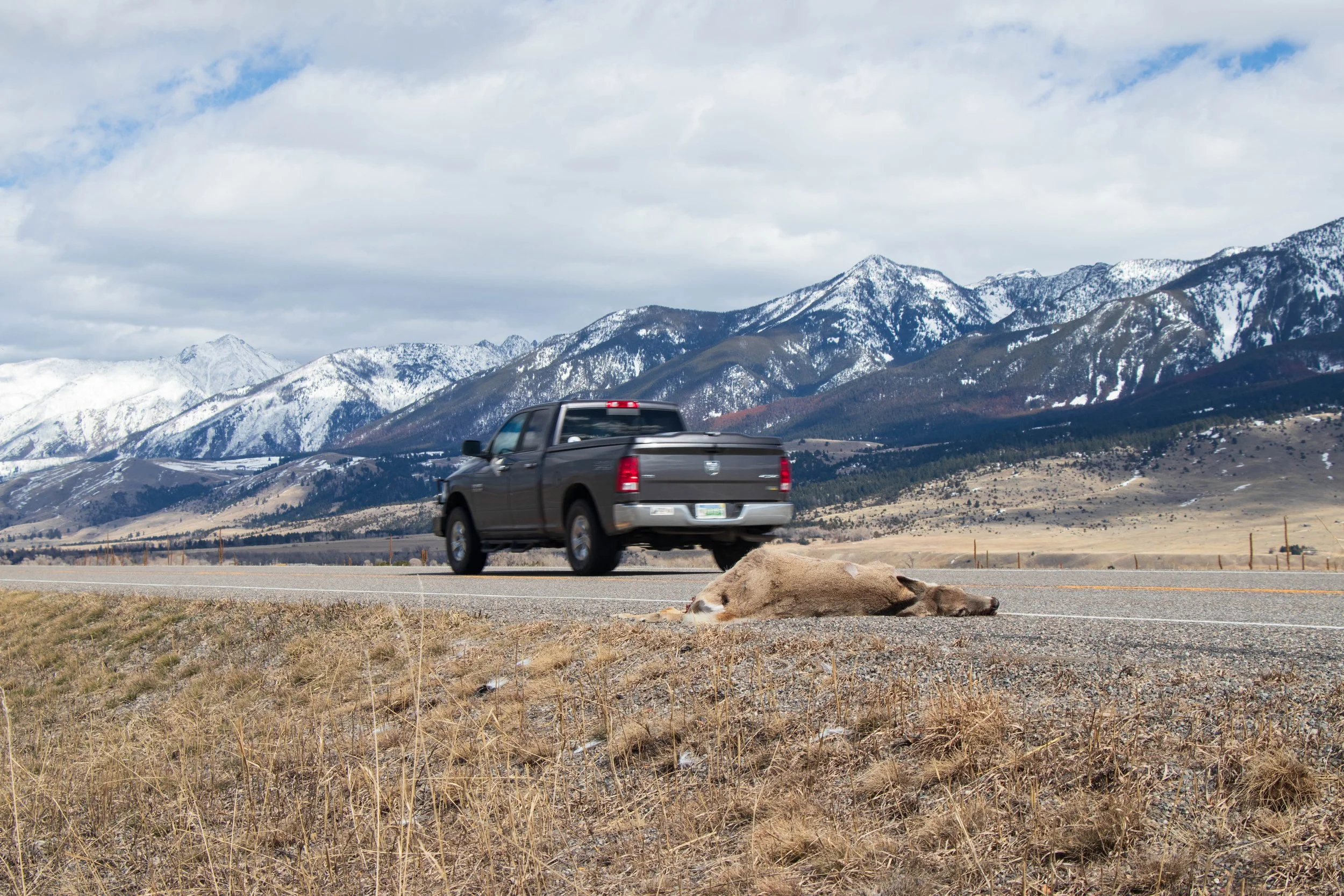
I had to stop this morning on my way into town to move a dead owl off the road. I nearly didn’t, but I couldn’t stand leaving it there. So I turned around, came back to park where I usually walk Hank, found some gloves in the back of the car and walked nervously up the shoulder 50 yards or so to where it lay, looking behind me every few seconds, afraid of meeting the same fate. I picked it up by its surprisingly thick legs, legs that ended in huge feathery feet with raptor claws, and carried it into the long grass of the ditch. I tried to put it to rest in a less chaotic state than I’d found it, but the wings still wound up splayed out and kind of in the wrong place. I couldn’t really see the face, and I didn’t want to look too hard. I tried to at least put it back in the correct bodily order, but it remained a heap of disorganized feathers. I apologized to it, then I walked, nervously, back to my car as trucks sped past me.
There’s a fox that was hit on that stretch earlier this summer who I haven’t been able to get out of my head. A lovely red dog fox, who lay out there for weeks. I still feel bad I didn’t clear him off the road, but I had neither gloves nor a shovel, and he was on the curve where the speed limit drops from 70 to 55, and I was both afraid of being hit, and self-conscious about wading out there to get him. And so, I watched all summer as that lovely animal was run over again and again, slowly crushed into the asphalt. I couldn’t get the thought of his bones out of my head. His organs. His beautiful tail. Crushed over and over and over again, by vehicles that had to swerve to hit him, for he was right on the center line. Vehicles like the one that hit him in the first place.
It’s only a fox, I could hear their voices. Why do you care so much?
Fake Violence/Real Violence
We were beset for several weeks this summer by a movie crew, funded by the right-wing activist Ben Shapiro, who chose Livingston as the place to shoot a very violent, pro-ICE fever dream of a movie. Because the local movie producer owns a building right in town, that’s where they built their main set, two false storefronts, a Pawn Shop and a Korean market. When the storefronts first went up, folks were kind of stoked. We lost our last Pawn Shop a year or two back, and a Korean market would be amazing in a place where the nearest Asian markets are in Salt Lake or Spokane. But alas, they were both false promises.
And then the production team staged a fake version of the murder of Renee Goode, on a residential street on my side of town, a car crash then shooting the actress driving the car. A stunt they filmed without having warned the people who lived on that block. Their hired armed private security guards, in full tactical gear, prevented people who lived there, people who had never been notified of the movie shoot, from getting back into their homes at the end of the day.
Then they started shooting on their pawn shop set, on a major street in downtown Livingston. They’d gotten a permit, but our permitting system was not set up for a violent movie production being run on the cheap, by people who were happy to run roughshod over the folks who live here. They blocked off the Food Resource Center, the only food bank in the county (a county comprised of 2800 square miles with approximately 17000 people). The food bank feeds 1 in 8 of those residents, and is only open on Tuesday and Thursday afternoons for a few hours. It’s located in a nice new building that went up about a decade ago, a facility designed to bring dignity to the clients, and where there is also have a commercial kitchen for rent, and that offers food service training courses. The movie set blocked off the primary entrance, and the private security, who looked very like ICE agents, were stopping cars and pedestrians (many of the clients don’t have cars) and asking them for ID. They terrified so many people that client visits were down 17% that week. Those are people who went without food that week.
In response, the city commission met twice, for more than 5 hours each session. Many of us testified in person and online about the effects of this event on our town. They’ve shot a lot of movies here, but as I noted, I’ve never been menaced by private security by any of those productions. They shot scenes for Certain Women in the alley behind my house. They notified me, asked me to move anything that looked modern including my car, shot for a day or two then put everything back. No one threatened me.
We all came together as a community to try to rein in the real violence this production was doing via their portrait of fake violence. It seemed we’d all come to an agreement, but the movie crew used the entire experience to gin up support for their central thesis, that protesters are Dangerous Radicals, refused to follow the guidelines set for them, and the police claimed, when called, that because those guidelines were not city, state or federal law, they had no authority to enforce them. The only one who could do that was the City Manager, who had signed off on the original permit, and who had left town for the duration. The only people cited were protesters, one of whom was releasing milkweed seeds into the air, another who was playing folk music, and another who was reading the US Constitution using a megaphone.
The commentary on social media, especially Facebook, was largely in support of the fake violence and the real violence it portrayed, claiming this portrayal was “free speech” and that supporting violence was “just an opinion,” therefore as valid as any other opinion. To no one’s surprise, threats against protesters and the businesses that supported them were rife.
It was three weeks of “It’s just a movie! Why do you care so much?”
Violence against art
And then, this week, the petulant billionaire who started Catapult press, then acquired Counterpoint, one of the seminal independent presses of the Bay Area, as well as Soft Skull and Hawthorne, two other independent presses who were publishing unique and experimental works that could not find homes elsewhere, killed off all four presses. She fired more than 20 career publishing professionals, tanked the careers of so many writers (including two in my personal social circle), and cast the fate of canonical American writers including Gary Snyder, Wendell Berry, and MFK Fisher into doubt — all because the workers had the gall to unionize.
Workers who began the unionization process after the same billionaire abruptly closed the successful magazine publishing arm of the same company, as well as the vibrant series of writing classes they’d been teaching. Both of which were vital sources of financial support for many in the creative community.
A community she’d supposedly started the company to support.
Can you imagine being the kind of person who would buy fine indie presses like Counterpoint, Soft Skull and Hawthorne, the latter one just last December, only to cast them aside like toys you’re bored with? These were dream publishers for many of us, publishers who supported their writers with tours and publicity and beautifully designed books.
And the billionaire’s daughter, herself a billionaire, shut them all down because the servants got uppity. No one knows who bought the presses. No one knows whether anyone bought them at all. No one knows what will happen to these crucial back catalogs.
Including the writers whose works are at stake.
However our social conditioning to suck up to the rich is so strong, that I have heard, from more than one affected writer, that the fault lies not with the billionaire, or the capitalist model in which publishers who buy your creative work then own that work in perpetuity, to do with as they will, including stop keeping it in print, but with the workers, whose efforts to unionize were selfish. Who blew it for everyone.
The continuing financial violence that the billionaire class is waging against us all has shifted me from “tax them at pre-Reagan levels” to “nationalize all fortunes over 1 billion dollars.” Take it all back. Put it into schools. Into feeding and housing people. Into supporting the arts. Into activities that are in direct opposition to the dog-eat-dog neoliberal violence we’ve been living under for decades now.
Opinions that have, on more than one occasion, been thrown back in my face with “Why should I care? I’m not an artist? I’m not poor? I’m not hungry.”
Now what?
This is where I’m supposed to wrap it all up with something I’m hopeful about, but I’m tired of the narratives of Hope and Change. I’m tired of the notion that it’s our individual responsibility to have a “good attitude” about these things, that by doing so we can affect change. I think change is harder than that.
I think change takes the kind of long-term action that only comes when the majority of people are so fed up that they can see no alternative. The kind of change that came after the Serbian student movement spent TWO YEARS in the streets, after they spent two years demonstrating and recruiting non-politicians to run for office. Non-politicians they just voted into a majority of their parlimentary offices. I am, actually, deeply hopeful about the political successes there and in Brazil this week, and that the Hungarians managed to not only boot Orban a while back, but in doing so dealt a major blow to the network of right wing propaganda and money that was being run through Hungary. While I’m cautiously hopeful about the French Protests, and about the chances of progressive politicians here like Abdul El-Sayed in Michigan and Talarico in Texas and Ossof in Georgia, I nonetheless continue to be horrified by the large and small violences that characterize the way we live now.
We are so accustomed to hierarchy and domination that we don’t even see it when we’re doing it. Think of all the social hierarchies and signals we participate on a daily basis — from the cars we drive to the coffee shops we patronize to the ways we decorate our houses to the people we invite out — to creative community I’m looking at you here, to the ways we’ve credentialized the arts whether by academic status or publishing house status or by the ways we include/exclude creatives from the various networks of power. The joke in writing programs was always that the poets were the most vicious because the stakes over which they were fighting were so small, and over the years as I have moved in and out of these spaces, these hierarchy games are usually what has driven me out.
Is there a way for us to rethink these networks? Is there a way for us to rethink the role of capitalism, and especially the way arts capitalism relies on the patronage of the Very Rich, in order to take back our means of production? To find ways to make and distribute art that don’t depend on us humiliating ourselves by begging for crumbs? To find real ways to collaborate in the production and distribution and creation of artistic work? And to, by extension, collaborate in the creation of more just economic and social networks in our world?
At one point this was the promise of the internet, but we all saw how that worked out. And as always, because this effort requires those who have managed to acquire the small but important markers of status in our different circles to relinquish them, to acknowledge that they are not the natural outcome of our status as Very Special Gifted Children, I fear for our ability to accomplish this. When times are hard as they are now, people cling to whatever status they’ve managed to achieve.
But what choice do we have? Are we at the turning point we’re seeing in other countries? Are we finally tired of dead animals on our roads, children murdered in our schools, our neighbors of color snatched off the streets by armed thugs, and the billionaire class draining us of our last dime so that they can show off for one another that their yachts contain nesting sets of yachts inside, like Russian dolls?
I don’t know how we get out of this mess, but I do think that naming the mess can be a place to start. I do think that stopping to move the dead owl off the road is worth the terror of being on the road in the first place, even if the best one can do is to try to arrange the poor thing in the closest approximation of it’s anatomical shape, before apologizeing as you leave it there in the frosty long grass of the ditch.
Leave a Reply